
Signs You Need
Tuckpointing
in St. Louis
And when you don't. Mortar joints fail for specific, diagnosable reasons. Before you spend money on repairs, know what you're actually looking at.
St. Louis freeze-thaw cycles are hard on masonry. But not every cracked joint needs tuckpointing, and not every job is the same. Here's how to read your chimney accurately.
Learn more about creosote removal St. Louis →
Learn more about chimney storm damage repair in Clayton, MO →
Learn more about commercial boiler flue cleaning in St. Louis, MO →
24/7 emergency availability ● No untrained subcontractors
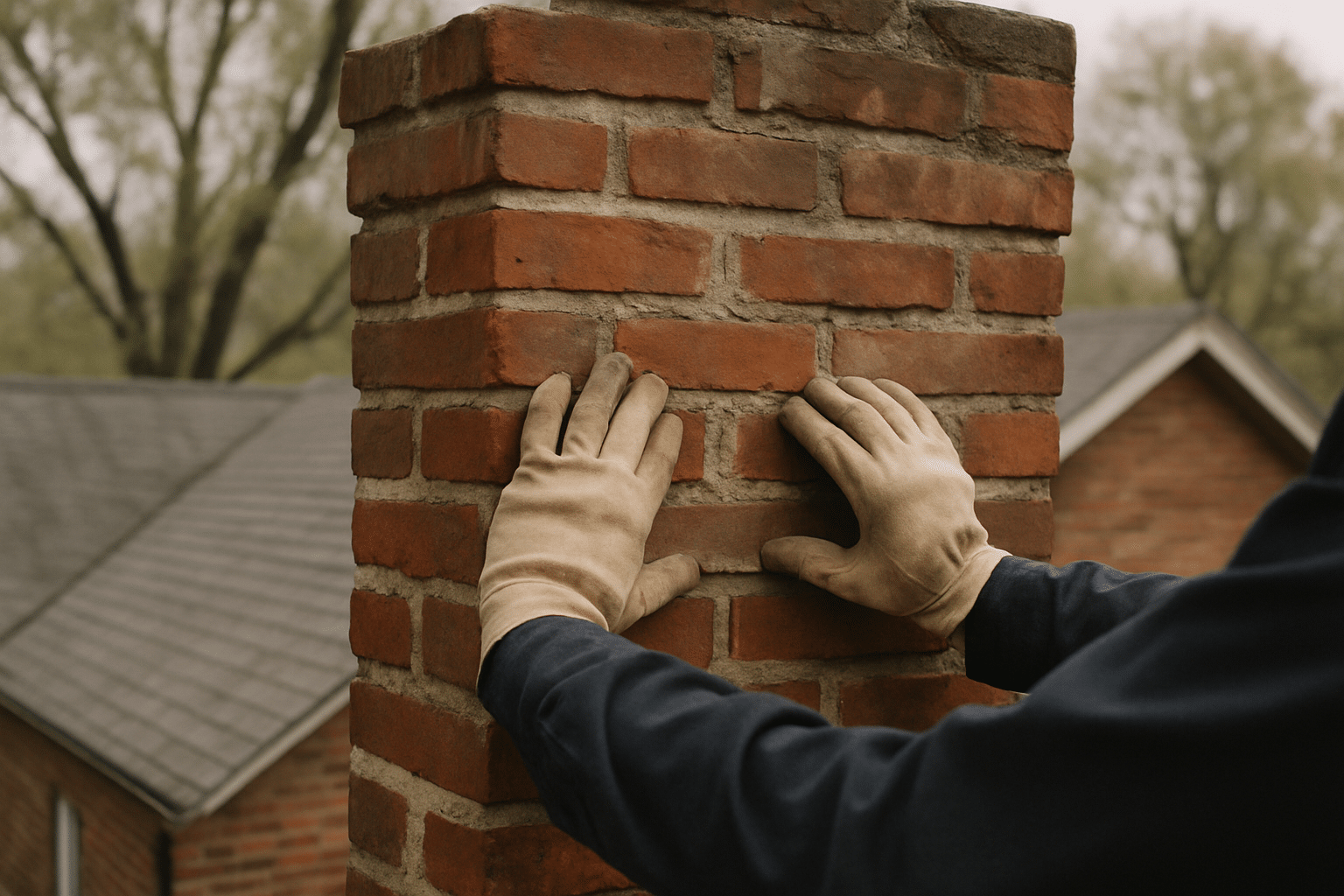
Clear Signs You Need Tuckpointing
These are the conditions that warrant action. Each one indicates active moisture intrusion or structural vulnerability.
Mortar Joints Recessed More Than 1/4 Inch
Run your finger across a joint. If it sinks in more than a quarter inch, the mortar has eroded past the point of shedding water. At that depth, rain hits the brick face and runs directly into the joint gap instead of dripping off the face. Repair within the season.
Crumbling or Soft Mortar That Comes Out by Hand
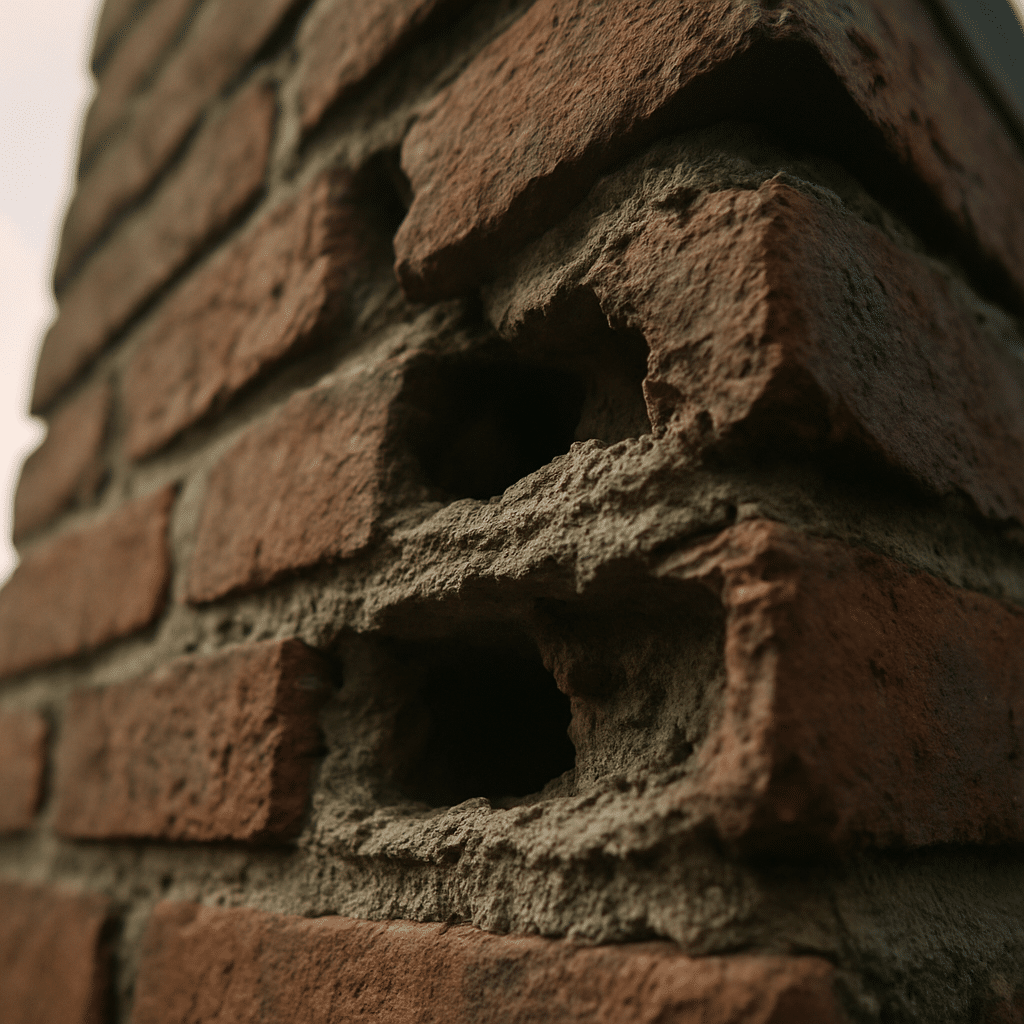
Healthy mortar is firm. If you can pick it out with a key or a fingernail, it has lost its binder. This typically happens after 20 to 30 years in the St. Louis climate, though it accelerates with improper original mix ratios or water infiltration from above.
White Staining (Efflorescence) on the Chimney Face
Efflorescence is the white powdery residue left behind when water carries dissolved salts out through the masonry and evaporates. It is not cosmetic. It is evidence that water is traveling through your mortar joints and into the brick body. Our chimney efflorescence diagnosis process identifies the source before any repairs begin.
Spalling Bricks
If the brick faces are flaking, popping, or breaking apart, that is a sign water has already entered the brick body and the freeze-thaw cycle has fractured it from the inside. Tuckpointing is needed, but it must be accompanied by replacing the damaged bricks. Tuckpointing alone won't fix a spalled face. See emergency spalling brick repair for urgent cases.
Water Stains Inside the Firebox or on the Ceiling
Interior water staining means the leak has been going on long enough to work through the chimney structure and into your living space. At this stage, tuckpointing is likely part of the repair, but a full leak diagnosis is required first. Joint failure is one of several possible sources.
Gaps at the Chimney-to-Flashing Junction
Where the metal flashing meets the chimney brick, mortar is used to seal the edge. When that mortar fails, it creates a direct water entry point at the roofline. This specific failure is sometimes mistaken for flashing failure. Both need to be assessed before deciding the repair scope.
When You Probably Don't Need Tuckpointing
Not every crack means the mortar has failed. Hairline surface cracks in sound mortar, less than 1/16 inch wide and not recessed, are common in older chimneys and often stable. A quick probe test tells us whether the mortar underneath is still solid.
Surface staining without efflorescence is another common false alarm. Dirt, algae, and old soot can make joints look deteriorated without any structural problem. Cleaning may be all that's needed.
If your leak is coming from a cracked chimney crown, failed flashing, or a missing cap, tuckpointing the joints will not stop the water. You are solving the wrong problem. A chimney that leaks from the top needs crown repair and waterproofing, not joint work. See our guide on custom chimney crown rebuilding for that scenario.
We do not recommend tuckpointing over visually fine joints just because the chimney is old. Age alone is not an indication for repair. The mortar condition on the shaded north face of a chimney often lasts significantly longer than the south-facing side on the same structure.
Not Tuckpointing Issues
- ◆ Cracked chimney crown
- ◆ Failed or loose flashing
- ◆ Missing or damaged chimney cap
- ◆ Interior condensation from flue sizing
- ◆ Surface dirt or algae staining
- ◆ Stable hairline cracks under 1/16 inch
Not sure what you have?
We diagnose before we recommend. Call us and describe what you're seeing.
☎ (314) 931-4541The Tuckpointing Process at EBS Chimney
From first look to final joint, here is exactly what we do and why each step matters.
Mortar Analysis
We test the existing mortar composition before ordering materials. Pre-1940 St. Louis brick almost always requires a lime-based mortar mix, typically Type N or a custom lime-sand blend. Using Type S or Type M Portland cement on older brick is a common mistake that accelerates spalling. The historic chimney tuckpointing process requires this step every time.
Mechanical Removal
Failed mortar is ground out with an angle grinder and cold chisel to a minimum 3/4-inch depth. Grinding too shallow leaves a thin layer that will not bond properly and will fail again within a year or two. This step takes the bulk of the job time. Most chimney tuckpointing jobs run 2 to 6 hours depending on chimney height and the number of joints requiring repair.
Wetting and Packing
Dry brick absorbs water from fresh mortar faster than the mortar can cure. We dampen the joint surface first. Then mortar is packed in firm layers, not just skimmed over the surface. The joint is tooled to match the original profile, which affects both appearance and water-shedding performance.
Cure and Waterproofing
Mortar needs 24 to 48 hours minimum before rain exposure. In St. Louis summers, we monitor the forecast and schedule accordingly. Once cured, a penetrating masonry waterproofing sealer is applied to the repaired area. This is not a surface coating -- it bonds into the masonry pores and allows vapor to escape while blocking liquid water entry. The National Center for Preservation Technology and Training (NCPTT) publishes guidance on masonry compatibility that informs our material selection on historic structures.
Tuckpointing and Chimney Safety: The Connection
Failed mortar joints are not just a water problem. A chimney with severely deteriorated joints is a structurally compromised enclosure. Smoke and combustion gases can escape through gaps in the chimney wall into adjacent living spaces instead of exhausting through the flue. Carbon monoxide exposure is a real risk in this scenario.
The National Fire Protection Association (NFPA) Standard 211 requires that chimneys be free of deterioration, obstructions, and combustible deposits before use. A chimney with open mortar joints does not meet this standard. The NFPA publishes the full standard at nfpa.org. Annual inspections are the mechanism by which this is confirmed.
If you have had a chimney fire, tuckpointing is often needed as part of the post-fire restoration, because the thermal shock from a chimney fire can crack and dislodge mortar throughout the entire chimney height. Our chimney fire inspection guide covers this in detail.
Homeowners sometimes ask whether they can tuckpoint themselves. The work itself is learnable. The mortar selection is not. Using the wrong mix on historic brick causes faster damage than doing nothing. If you have a post-1990 chimney with standard modular brick, a patient DIYer can handle small sections with pre-mixed Type S mortar. For anything older, or anything more than a few joints, the risk of mismatched mortar is significant enough that professional analysis pays for itself.
Cost Factors for Tuckpointing in St. Louis
Honest ranges. The price depends on several real variables, not a flat rate.
Chimney Height and Access
A single-story chimney visible from a ladder costs less to repair than a three-story chimney requiring full scaffolding. Scaffold setup is a real cost that flat-rate pricing ignores.
Extent of Joint Failure
Spot repairs on 10 to 20 joints cost a fraction of full repointing on all four faces. We document exactly which joints are failing so you know what you are paying for.
Mortar Type Required
Custom lime-based mortars for historic structures cost more to source and mix than standard premix. They also last longer and protect the brick. Cutting corners here is false economy.
Combined Repairs
If the crown is cracked and the joints are failing, combining those repairs in a single visit costs less than scheduling two separate jobs. Ask about scope during your estimate.
Costs vary with chimney height, condition, and scope. We provide written estimates before work begins. Call (314) 931-4541 or visit the contact page for a free on-site evaluation.
Related Chimney Services
Tuckpointing is one component of chimney health. These related services are often needed alongside or after joint repair.
Full-scope chimney repair services for St. Louis homeowners.
Identify the source of salt deposits before they become structural damage.
Proper crown design stops water at the source and protects joint work below.
Replace freeze-fractured bricks before the damage spreads to the chimney structure.
Mortar matching and lime-based repair for St. Louis period homes.
Forensic water entry analysis when the source is not immediately obvious.
Frequently Asked Questions
How do I know if I need tuckpointing or a full chimney rebuild?
If the brick faces are structurally intact and the mortar is the primary failure point, tuckpointing is the right scope. If bricks are cracked through their depth, leaning, or missing entirely, a partial or full rebuild may be required. We assess this during the free estimate. No charge to tell you where you actually stand.
How long does tuckpointing last?
Properly matched mortar, installed at the correct depth on dry masonry, typically lasts 20 to 30 years in the St. Louis climate. Surface-applied "pointing" that is only 1/4 inch thick may fail within 3 to 5 years. The preparation depth is the single biggest variable in longevity.
Can I tuckpoint in winter?
Mortar cannot be applied when ambient temperatures are below 40 degrees Fahrenheit or expected to drop below freezing within 24 hours of application. Cold inhibits the curing reaction and produces weak mortar that fails quickly. We schedule around these conditions. Emergency structural repairs in winter require heated enclosures, which adds cost.
Does tuckpointing fix a drafting chimney?
Draft problems are almost never caused by mortar joint failure. Draft is determined by flue height, flue diameter, chimney height relative to the roofline, and fireplace opening geometry. If your chimney smokes back into the room, you need a forensic chimney draft analysis, not tuckpointing.
What is the difference between tuckpointing and repointing?
Technically, repointing describes the full process of removing and replacing mortar. Tuckpointing in its original definition was a decorative technique using two-color mortar. In modern American trade usage, they are used interchangeably to mean the same repair process. When someone quotes you "repointing," confirm the removal depth. That tells you more than the label.
Does a cracked chimney crown mean I need tuckpointing?
Not necessarily. A cracked crown allows water in from the top, but the joints below it may be perfectly intact. Fixing the crown while ignoring deteriorated joints means the water simply finds a different route. Both need to be assessed. We look at the whole chimney system, not individual components in isolation.
More specific questions? Visit our chimney diagnostics FAQ hub or read the Chimney Safety Institute of America (CSIA) guidelines at csia.org.