
Mitigate Property Management Liability Instantly Without Disrupting Tenant Parking Across Your Complex
We offer dedicated account managers and digital portal tracking for all units, providing real-time compliance reports instead of scattered paper invoices.
As the premier offering within our St. Louis commercial & HOA chimney services, we protect your board from fire liability
What Is an HOA Chimney Maintenance Contract?
An HOA chimney maintenance contract is a scalable, B2B service agreement providing synchronized bulk chimney sweeps, structural inspections, and centralized reporting for multi-unit properties. It guarantees strict fire code adherence and neutralizes property management liability by systematically documenting the safety of every tenant flue through a centralized digital portal.
Managing a single residential chimney is straightforward; managing three hundred active fireplaces across a sprawling multi-family housing development is a logistical minefield. Property managers cannot rely on tenants to individually coordinate their own sweep and inspection services. When an HOA leaves fire safety up to the renters, severe neglect is mathematically guaranteed. A commercial maintenance contract shifts that operational burden entirely onto our dispatch center. We coordinate the fleet, handle the complex tenant scheduling blocks, execute the physical sweeping, and deliver the exact legal documentation your board of directors needs to satisfy your master insurance policy.


High-density living structures carry compounded risks during the freezing St. Louis winter. When temperatures plummet along the I-270 corridor, hundreds of tenants simultaneously ignite fires to offset their heating bills. In a multi-family building, a single tenant burning unseasoned wood or heavy paper trash in a neglected firebox does not just threaten their own unit; it threatens the entire block.
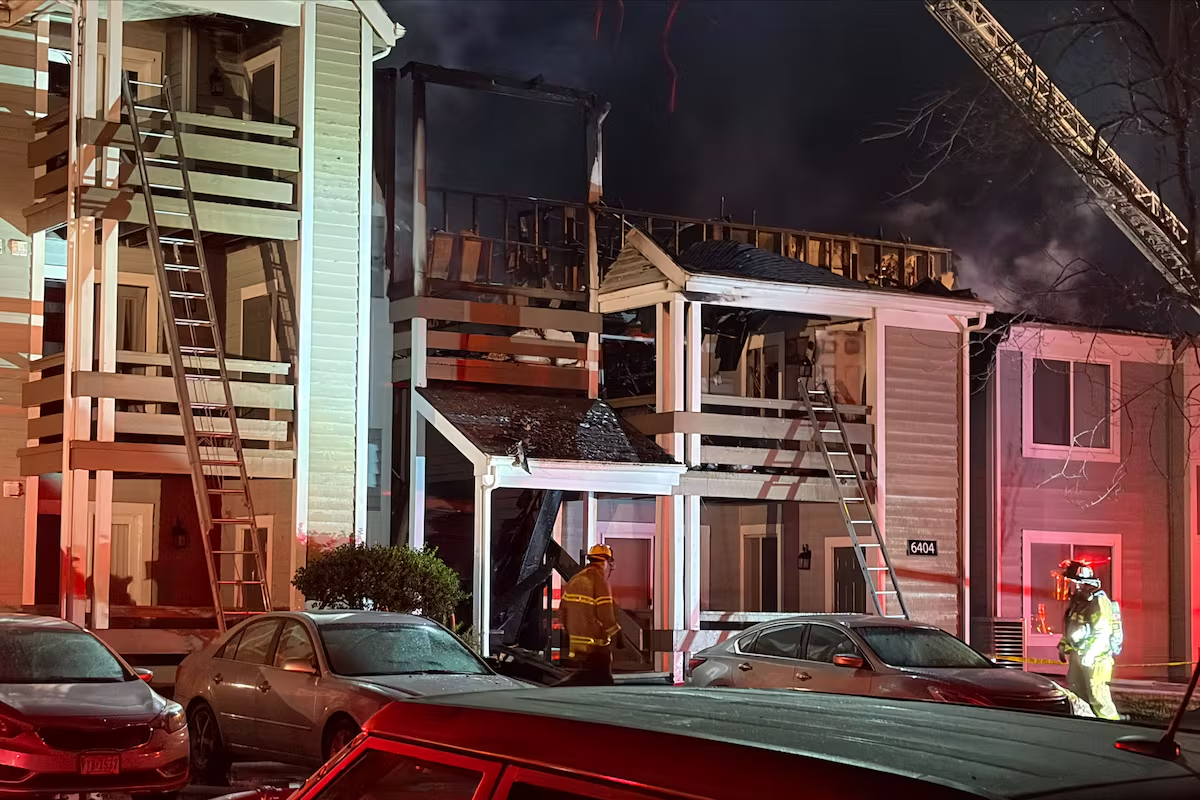
A flue fire that breaches the masonry in unit 1A will instantly travel through the shared wooden framing into unit 2A, risking a catastrophic multi-alarm structure fire. Protecting these shared walls requires aggressive, preemptive maintenance. We deploy heavy-duty commercial extraction equipment to strip the highly flammable creosote out of every connected flue before the first freeze hits.
Why Central Overland Dispatch Minimizes Tenant Disruption
When you hire a contractor to service a massive condo complex, their vehicles can easily paralyze your property. Uncoordinated trucks block tenant parking spots, choke emergency fire lanes, and create a chaotic environment for days. Operating centrally out of Overland allows us to strategically dispatch our commercial fleet. We utilize route-optimization software to stagger our arrivals, servicing entire buildings in calculated blocks. We get in, secure the flues, and clear your parking lots before your tenants return from work.
Preventing a Multi-Unit Fire in a Chesterfield Condo Complex
Last September, a property management group took over a massive 120-unit condo complex in Chesterfield. The previous management company had ignored the fireplaces for five years. The new board asked us to perform a baseline audit. I mobilized a four-truck fleet, and we systematically worked through the buildings.
The neglect was terrifying. In one specific eight-unit block, every single terra cotta clay liner was choked with hardened Stage 3 creosote because the tenants had been burning wet pine construction scraps they found near a dumpster. Several of the cast-iron throat dampers were rusted completely shut, meaning any fire lit would have immediately backed up carbon monoxide into the units. We locked out the dangerous fireplaces immediately, presented the board with photographic evidence of the hazard, and executed a synchronized bulk chimney sweep over the next three days. We stripped the glazes, replaced the seized dampers, and brought the entire complex back into code compliance, successfully averting what would have been a devastating winter fire.

The Severe Liability of Neglected Tenant Fireplaces
If a chimney fire destroys a multi-family building, the ensuing litigation is brutal. Insurance investigators will demand proof that the property management firm upheld its duty of care. If you cannot produce certified inspection records proving the flues were swept and structurally sound, the HOA can be found grossly negligent. This exposes the board to massive property management liability, massive lawsuits from displaced tenants, and the total cancellation of your commercial insurance policy.
You cannot assume a chimney is safe just because a tenant has not complained about smoke. Renters frequently bypass safety protocols, using fireplaces as incinerators for cardboard boxes or holiday wrapping paper, which causes extreme temperature spikes and instant clay tile fractures. Our fleet maintenance contracts eliminate this blind spot. We put eyes and cameras inside every single flue, legally documenting the structural integrity of your asset.

Securing Your Properties Even If Previous Contractors Left a Mess
Property managers frequently contact us in a panic because their previous chimney vendor went out of business mid-season, or because a cheap contractor did a sloppy job, skipping units and losing the paperwork. The board is furious, the winter is approaching, and the manager has no idea which fireplaces are actually safe to use.
Even if your current maintenance records are a complete disaster, our fleet can step in and immediately establish order. We perform rapid baseline audits across disorganized portfolios. We will physically verify the status of every flue, tag the mechanical hardware, and rebuild your compliance database from the ground up, giving you a clean slate and total control over your property’s fire safety.
Managing 1980s Prefabricated Flues in Suburban Townhomes

A massive percentage of the townhomes and multi-family developments built in the St. Louis suburbs during the 1980s rely on factory-built, prefabricated metal chimneys rather than traditional masonry. These systems feature metal exhaust pipes hidden inside wood-framed chases wrapped in vinyl siding.

When these sprawling complexes were framed, the original builders were focused on speed, not longevity. They installed cheap, galvanized steel chase covers that are now uniformly rusting out across entire neighborhoods. This allows water to leak directly into the shared wooden framing, causing severe rot between the units. We specialize in retrofitting these aging developments. We fabricate custom, 304-grade stainless steel chase covers in bulk, executing complex-wide upgrades that stop the water ingress and permanently protect the structural framing of your buildings.
Correcting Widespread Builder-Grade Oversights
Respecting Tenant Units During High-Volume Sweeps
The fastest way for a property manager to lose their job is to hire a contractor who disrespects the tenants. If a sweeping crew tracks black soot across fifty different white living room carpets, your phone will ring off the hook with furious renters demanding compensation.
We protect your relationship with your tenants through militant cleanliness. Our commercial technicians wear clean uniforms and surgical-grade shoe covers. Before we open a tenant’s firebox, we lay down heavy canvas drop cloths covering a ten-foot radius. We utilize H-Class HEPA filtration vacuums that capture 99.97% of the carcinogenic ash down to 0.3 microns, ensuring the air inside the apartment remains pristine. We leave the units exactly as we found them, generating zero complaints for your management office.
The Stress of Juggling Multiple Unreliable Subcontractors
Managing a large property means you are constantly putting out fires both literal and figurative. Dealing with a chimney contractor who doesn’t answer the phone, misses scheduled tenant appointments, or fails to send over the necessary W-9s and insurance certificates is an exhausting waste of your time. You are forced to act as a babysitter instead of a property manager.
We eliminate this operational friction. By partnering with our commercial division, you stop playing phone tag. We provide highly structured, predictable logistics. We show up on the exact day we promised, we complete the block of units on time, and we automatically upload the data. We replace the headache of subcontractor management with the relief of a fully delegated, highly professional service machine.
Our Streamlined Timeline for 100+ Unit Service Cycles
Executing a bulk sweep across hundreds of units requires military-level logistical planning. We do not wing it. We provide your management office with a rigid, highly communicative timeline.

Two weeks prior to deployment, we provide your office with standardized digital and physical notices to distribute to the tenants, detailing the exact day and two-hour time block we will need access to their unit.

Our crews arrive on site, establish a centralized staging area to avoid blocking traffic, and move systematically through the buildings floor by floor, executing the sweeps and HEPA vacuuming.

Within 48 hours of completing the physical work, all inspection reports, safety lock-out notices, and completion signatures are verified and pushed live to your digital portal for immediate board review.
Your 3-Step Path to Complete Property Management Compliance
We remove the anxiety of a massive backyard renovation by following a highly communicative, three-step B2C journey.
We walk the property with your management team, identify the specific type of fireplaces installed (masonry vs. prefabricated), evaluate the roofline access, and determine the exact scope of the liability risk.
We mobilize our technicians to perform the physical cleaning, mechanical extractions, and structural inspections, adhering strictly to the agreed-upon tenant scheduling blocks.
We hand over the hard data. We populate your custom dashboard with every necessary NFPA 211 report, giving you the exact, irrefutable documentation required to prove your compliance to your insurance underwriters.
Transparent Bulk Pricing Without Surprise Trip Fees
Bidding a massive commercial contract requires accuracy. Many sweeping companies will quote a low per-unit price, but then secretly tack on massive “trip fees,” “setup fees,” or “equipment surcharges” for every single building they enter. This blows your annual maintenance budget out of the water.
Dedicated Account Managers for Accurate Billing
We operate on total financial transparency. We assign a dedicated account manager to your portfolio who provides a strict, flat-rate, per-unit pricing structure based on the volume of the contract. The price we quote for the bulk sweep is the exact price you pay. If our technicians discover a cracked clay tile or a rusted chase cover that requires an additional mechanical repair, we generate a separate, line-itemized quote for your board to approve before any extra work is executed.
Partner With EBS Home Care LLC for Commercial Fleet Maintenance
Protecting a multi-family housing development from fire hazards requires heavy logistical coordination, high-volume manpower, and absolute digital accountability. You cannot trust your master insurance policy to a disorganized, single-truck operator holding a paper notepad.
Operating directly from our Overland, MO headquarters, EBS Home Care LLC delivers enterprise-level chimney fleet maintenance to property managers and HOA boards across the Greater St. Louis area. We strip the creosote, neutralize the liability, and prove your compliance through advanced digital reporting. Do not wait for a tenant to start a multi-unit fire. Contact our commercial division today to secure a dedicated account manager and bulletproof your property portfolio.
HOA Compliance: The Hard Truth About Bulk Sweep Costs, Fire Codes, and Property Management Liability
How much does a bulk HOA chimney maintenance contract cost per unit in Overland, MO?
The average cost for a bulk HOA chimney maintenance contract ranges from $85 to $135 per unit, depending heavily on the total volume of fireplaces within the complex. This bulk rate is significantly lower than our standard single-family residential sweep fee. We provide property managers with a dedicated account manager who generates a strict, flat-rate bid covering the physical cleaning, the NFPA 211 Level 1 inspection, and the digital portal tracking for the entire portfolio.
What are the specific St. Louis County fire codes for multi-family chimney inspections?
The 2015 International Fire Code (IFC), as adopted and amended by St. Louis County, strictly mandates that chimneys, fireplaces, and solid fuel-burning appliances in multi-family dwellings be professionally inspected at least once a year. Failure to execute these annual inspections can result in severe citations from the local municipal fire marshal and the immediate cancellation of your master insurance policy. Our commercial fleet provides the exact, standardized compliance reports required to legally indemnify your board of directors.
Do tenants need to be home while you perform the multi-unit chimney sweep?
No, tenants do not need to be present as long as your property management office provides our commercial fleet with supervised key release or on-site maintenance escorts. To ensure flawless execution across a 100-unit complex, we supply your office with standardized tenant notification templates two weeks prior to deployment. Our technicians utilize drop cloths and H-Class HEPA vacuums to guarantee every apartment remains spotless, minimizing tenant disruption while we work.
What kind of liability insurance do you carry to protect our property management firm?
We carry over $2,000,000 in specialized commercial liability and workers’ compensation insurance designed explicitly for high-volume, multi-story masonry operations. We routinely issue Certificates of Insurance (COI) that legally name St. Louis HOA boards and property management firms as additional insured entities. This robust coverage completely insulates your organization against fire-related tenant claims or accidental structural damage that might occur during the bulk chimney sweep.
What is the difference between using on-site maintenance staff and a commercial chimney sweep fleet?
An on-site maintenance technician lacks the specialized rotary extraction equipment, the Chimney Safety Institute of America (CSIA) certifications, and the specific liability coverage required to legally sweep a solid-fuel appliance. A commercial chimney sweep fleet brings synchronized manpower and advanced camera diagnostics to process hundreds of units rapidly and to code. Relying on an uncertified handyman to manage combustion systems exposes the HOA to massive property management liability in the event of a multi-unit structure fire.
Do you prioritize emergencies for existing HOA maintenance customers in St. Louis?
Yes, we provide guaranteed, front-of-the-line emergency dispatch for all property managers enrolled in our commercial service agreements. If a tenant reports a sudden carbon monoxide alarm, a seized throat damper, or a smoke backdraft during a freezing winter night, our rapid-response units deploy immediately from our Overland hub. We bypass standard residential queues to secure the compromised unit and mitigate the life-safety hazard before it affects neighboring apartments.
What happens to the price if you find additional problems during the NFPA 211 Level 1 inspection?
The per-unit price for the bulk sweep never changes; if we find a hazard, we flag it in your digital portal and issue a separate, no-obligation quote for the repair. If our technicians discover a cracked terra cotta clay liner or severe galvanized steel rust on a chase cover, we immediately place a safety lock-out tag on that specific fireplace. Your dedicated account manager then submits photographic evidence and a line-itemized structural quote to the board, ensuring zero unauthorized charges are added to your invoice.
How long does a typical chimney sweep appointment take per tenant unit?
A standard commercial chimney sweep and Level 1 inspection takes exactly 20 to 30 minutes per tenant unit. Because we deploy a highly coordinated, multi-truck commercial fleet, we process entire building blocks simultaneously rather than one at a time. This military-level logistical planning allows us to secure massive multi-family housing complexes across St. Louis County in a fraction of the time it would take a disorganized, single-operator contractor.